Over the past 25 years, Wikipedia has always been a controversial website. I have heard many things about Wikipedia, good and bad, through teachers, friends, family, the media, and random people online. Many have seen it as reliable because you can use it for anything and anyone, however, others have viewed it as unreliable because of how easy it is for one to add misinformation to the site. For example, in 2007, a professional wrestler named Chris Benoit killed his wife, son, and then himself. However, before the authorities discovered that the incident happened, someone wrote on Benoit’s Wikipedia page that “As Benoit was not there due to personal issues, stemming from the death of his wife Nancy.” That not only raised a lot of suspicion about the case, and the publisher, but about Wikipedia as a whole, and it questioned whether or not Wikipedia is a strong source or a weak facade. However, that’s a very niche detail about one person’s Wikipedia page out of everyone else’s, which is a very small percentage, so it doesn’t automatically kill Wikipedia’s credibility. Some things that might be helpful about Wikipedia are learning facts about your favorite topics, whether it’d be sports, TV shows, reality, crime, what have you. Some stuff that could be dangerous or harmful about Wikipedia are spreading false information, or potential personal bias on how articles are presented based on the publisher. Overall, I think there are more benefits than dangers when it comes to Wikipedia, especially when the bigger danger, AI, is taking over. I have used Wikipedia ever since the third grade because that was when I started using laptops in school, and that was also the year when I got my first personal laptop. For the past 11 years, I have used Wikipedia for school related topics, college projects, and information on professional wrestlers, MMA fighters, TV Shows, movies, actors, random celebrities, and other real-world topics. I’ve used it much more for personal “fun” reasons than I have for school-related reasons. Wikipedia has been a very reliable source for me for over a decade and has been an overall successful, reliable source for the entire world for 25 years now.
Author: admin
-
Distant Reading Reflection
The texts that I am analyzing are ” ‘Out of touch’: Dave Ramsey slams Philadelphia couple for paying $80K/year on child care — and some parents on TikTok now think Ramsey owes them an apology. Are they right,?” “What Dave Ramsey and Caleb Hammer Taught Me About Handling Money,” and “Caleb Hammer says Dave Ramsey is ‘clueless’ when it comes to the ‘$1,000 emergency fund’ strategy.” I chose to analyze all three of these texts overall, and I analyzed them both combined and separately. First, what I did was I took each article, pasted it into a google doc, took out the inclusions that weren’t “words” in the articles like titles, advertisements and descriptions, and then pasted what was remaining into Word cloud one by one. Each article of words that was pasted provided me with different word scrambles, with the words that were most frequently used being the largest and the words that were only used once being the smallest. As far as Voyant goes, I took all 3 of my main articles, including their titles, and I pasted them into Voyant. The results that showed up were cool, because on the left showed a word scramble like word cloud. On the right showed a statistical graph where words that were used the most were part of a long line graph. Not only that, but you can change the graph but plugging in specific individual words to see what the ratios look like. The division was mostly in Word Cloud since Word Cloud analyzed each article’s words individually, however, division is Voyant is through the search of the specific words to look for different ratios. There’s both combination and division in these visualizations. My 3 main observations from the visualizations in Word Cloud and Voyant were that Voyant was objectively better because it provided a word scramble AND a graph, whereas Word Cloud only provided a word scramble, word cloud’s word scramble was more effective because its sole focus was on the scramble rather than multiple visuals, and Voyant was more simplified because it summarized all 3 articles at once, whereas Word Cloud summarized each article’s words individually. In order to see the texts from another direction, I would change the scale in my word scramble, type in multiple individual words into the Voyant document in order to see a different scale, adjust the scale of the context, and click on the “sort ascending” button. There are many different ways to get different results, and they are all very interesting methods. From these visualizations, I learned that words that are most commonly used, whether the article is in favor of Dave Ramsey or Caleb Hammer, are words such as “Emergency, Hammer, Ramsey, debt, people, right, afford, financial, bank, research, time, and manage.” This shows that no matter whose perspective that you’re speaking from, the message is the same. And that message is to save as much as you can, build yourself up, work as hard as you can, budget, take your time, trust the process, and be patient. If you can follow all of these steps, the sky’s the limit. All of the texts and visualizations from both Voyant and Word Cloud all sent the right message to be as financially responsible as you can.
-
Free Topic 2: Frankenstein
Throughout the past month in TPS Lit: Digital Humanities, I have had the opportunity to read Frankenstein, a story about a scientist named Victor Frankenstein who had a passion for creating life, and decided to invent a creature from scratch, but then later abandons it. I won’t deny that it’s a good story, however, there’s one overarching theme that I can’t stand, and we get reminded of it constantly, and that theme is that Victor is depressed. Victor is sad, Victor is lonely, Victor can’t control his emotions, Victor doesn’t know what to do. I feel like every chapter, it all revolves around Victor becoming happy, and then getting sad again and then back and forth. On top of the fact that he’s always depressed, he uses it as an excuse for his poor decisions, like when he abandoned the creature. This has caused me to develop a bigger distain for the Victor character than I did for Holden Caulfield from Catcher in the Rye. The similarities between the two characters are insane. Depressed, sad, annoying, hypocritical, and no accountability taken. Frankenstein is no doubt a good story, and if the point is for readers to not like Victor, then job well done.
-
Distant Reading Project
It is my responsibility to find an interest that’s related to my field of study to use for my distant reading project. I am an accounting major because I’m pretty good with numbers and I’ve always tracked down my earnings, which made accounting an easy choice. However, I’m not only a fan of numbers, I’m also a fan of podcasts, and I enjoy podcasts pertaining to any topic that I have any interest in, whether it’d be professional wrestling, MMA, or financial podcasts. I discovered financial podcasts relatively recently, and I’ve enjoyed them ever since. Specifically, the podcasters that I’ve enjoyed are Caleb Hammer and Dave Ramsey. And since I am an accounting major and Hammer and Ramsey are financial podcasters, I feel that it’s only appropriate that I use them for my project, especially considering that podcasting is arguably the most professional form of entertainment. When I did some research, I found three specific articles that piqued my interest. Those three articles were “Caleb Hammer says Dave Ramsey is ‘clueless’ when it comes to the ‘$1,000 emergency fund’ strategy,” “Here’s why financial expert Caleb Hammer refuses to pay down his student loans of $35K — while screaming at other young Americans for being deep in debt. Should you copy his tactic?” and “What Dave Ramsey and Caleb Hammer Taught Me About Handling Money.” What made me interested in these specific texts is that you get two articles that have an argument for which expert is better, one for each expert, and then you get an article that brings everything to a common middle ground and explains why both are helpful and useful. To quote a character from one of my favorite TV Shows, “There’s 3 sides of the story. There’s your two sides, and then there’s the truth.” And when you think about it, that’s what it seems like here, which is why I wanted to dive deeper into this topic. I wanted to talk about how both experts are helpful and how they are helpful in their different ways, different methods, and different pieces of advice. You might ask, “What makes them so interesting?” And to that I say some of their personal experiences that I knew about prior to this project are pretty interesting. Now, I know more about Hammer than Ramsey, because I watch Hammer more, however, I know that both of them have been deep in debt, both got themselves out of debt, and both have helped gotten many others out of debt as well. What I also know about them that I honestly enjoy hearing is they both have a “tough love” kind of approach to where they tell their guests things such as “Stop buying unnecessary things,” “You need to struggle a bit,” or “You can’t be traveling and eating out when you can’t afford it.” They both know that in order to be effective experts, they have to really get their advice through their guests’ heads so that they can pull them out of debt, and that’s why I respect and support them. One of the reasons why they’re so determined to pull people out of debt is because they themselves were in debt before that almost ruined their lives. Hammer was deep in student loan debt as a music student at Western Michigan University, and Ramsey had to file for bankruptcy almost 30 years ago for losing $4 Million in real estate. Even though it seemed like both of them were doomed, they managed to pull through by living paycheck to paycheck and saving every penny they made until they were financially stable. And just like the three articles, while they got into debt differently, they met a middle ground of budgeting and saving until they reached stability. As far as what I look forward to learning about them, I look forward to discovering what mistakes they made that they prevented their guests from making, how they manage their money now that they’re comfortable, and where and who they learned from the most. By diving deeper into their stories, I believe that I will learn more about their biggest strengths, their biggest weaknesses, and whether their critics or the fans are more validated.
-
Data Project: Balancing Schedule & Time Alone
Jack Horton
Professor Patrick
Honors TPS Literature: Digital Humanities
16 February 2026
Data Project: Reflection
For this project, I did a six-day analysis on balancing my schedule, and I did a one-day analysis on my time alone. There were some things that I enjoyed and some things that I didn’t enjoy about collecting data about myself. What I didn’t enjoy was having to remember every hour of each day for nearly a week to jot down what I did on my notes app. However, what I did enjoy was writing the progress that I made because it boosted my confidence and self-esteem. What I also enjoyed was looking back on previous days on my schedule to look for pattern recognition, whether I do certain things at similar times or different times, what I did on Saturday that was completely different from what I did on Tuesday, etc. What this data illuminated was that I can have a fun, relaxing life while also remaining productive. I can go to class, do homework, eat well, go to the gym, work a part time job, and still have time to sleep, relax, have fun with friends, and have plenty of time to myself. What this data also illuminated was that whether I am alone, or with someone, whether that’d be friends, family, co workers, or associates, I am happy because I am in a comfortable spot. I have a roof over my head, both on and off campus, I have an on and off campus job as sources of income, I’m an honors student, I have the ability to dorm on campus, I have no debt, and I have very little in terms of responsibilities. When I think about all of this and realize that I am very fortunate, why would I bother thinking differently about being alone or being with others? As long as my interactions are good and I can be just as comfortable alone, I have no complaints. Some of the choices that I made that helped the process was setting reminders on my phone to write down my hourly schedule. Other choices that I made that helped the process was making sure I went to the gym five out of the six days, working over the weekend, and spending a good amount of time on my schoolwork, because this made my schedule productive, well balanced, and proud to reflect on. Another small detail that helped me was that I jotted down how I felt when I was alone, with people, and alone again on Friday in order to be able to reflect on the differences and similarities. However, some of the choices that I made that were poor were that I scrolled on my phone too much, I went to sleep at different times throughout the different days, and ate breakfast, lunch, and dinner at different times, which created some inconsistency and imbalance. However, while there was some imbalance, I was still able to get everything I needed to do despite the unproductive imbalances. Therefore, the balance outweighed the imbalance. Throughout this data project, I learned that I am inconsistently consistent. And what that means is that while I do everything spontaneously, I get my progress done at the end of the day, which helps keep my self esteem up. While it would be wiser to have an exact routine, it’s almost impossible to do that because I have different class schedules on different days and work at different times, and different physical feelings on different days. For example, one day I’ll feel tired, so I would make a decision to work out at night instead of the morning. While on another day, I’ll feel great and workout before my classes start. This data project made me remember an important life lesson. Life is hard, and life will always get in the way of your progress. The importance of life is figuring out how to work around your problems and be as productive as possible, whether you’re having the best day ever or the worst day ever. While I had some self reflections, this data project didn’t just give me realizations about myself. It gave me realizations about data as a whole and how much effort is put into data. While it may seem like a piece of cake at first, the more you do it, the more you realize how annoying it can get and how much skill and strong memory is required to be effective in data tracking. It also made me realize how hard people work who have to track data for a living, whether it’d be on celebrities, professional athletes, organizations, buildings, chains, cities, what have you. I also realized that learning how to data track is an essential skill to learn in order to prepare to live on your own because once you’re out in the real world by yourself, you are going to have to remember things that you didn’t even consider beforehand. And while the internet can be a reliable best friend, remembering essential skills and remembering to track things consistently not only grows your brain and skillset, but it also gives you a strong sense of pride. Overall, what I learned about data through this project was that it was the first step in the long process of my colleagues and I having successful futures.
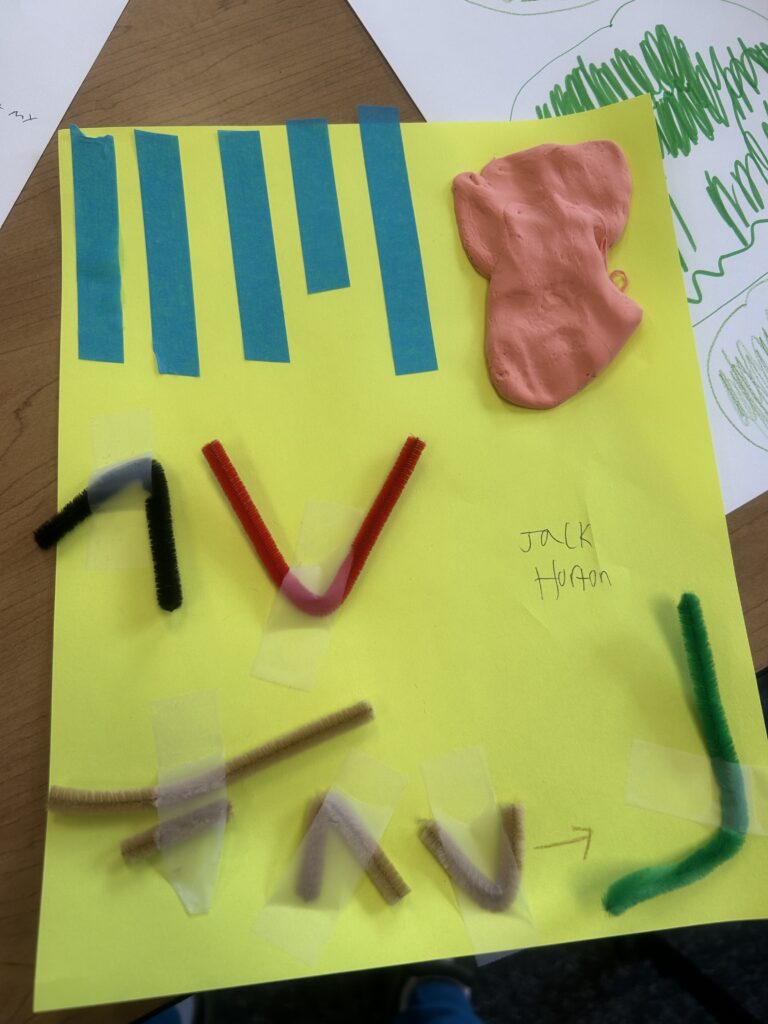
3D Visualization Explanation: Balancing My Schedule
The Blue Tape represents consistency and going to the gym five times a week. Tape ensures security, and much like security, my gym consistency is locked in and won’t change.
The Black and Red furry pipes represent my job.
The purpose of the black downward pipe is that working is a pain at first, but the red upward pipe means that it will get easier and much more tolerable as time goes on.
The Gold furry pipes represent schoolwork. Each gold pipe is different.
Long: Long Process
Small: Short Process
Downward: Not feeling good while working.
Upward: Feeling optimistic and focused while working.
Green Pipe: Check Mark
Purpose: No matter how long it takes or how I feel, I find a way to get my schoolwork done effectively.
Peach Clay: Represents social time
The big piece of clay means that even though I don’t do it much, whenever I hang out with friends, it’s eventful, unique, and well worth the time, just like clay.
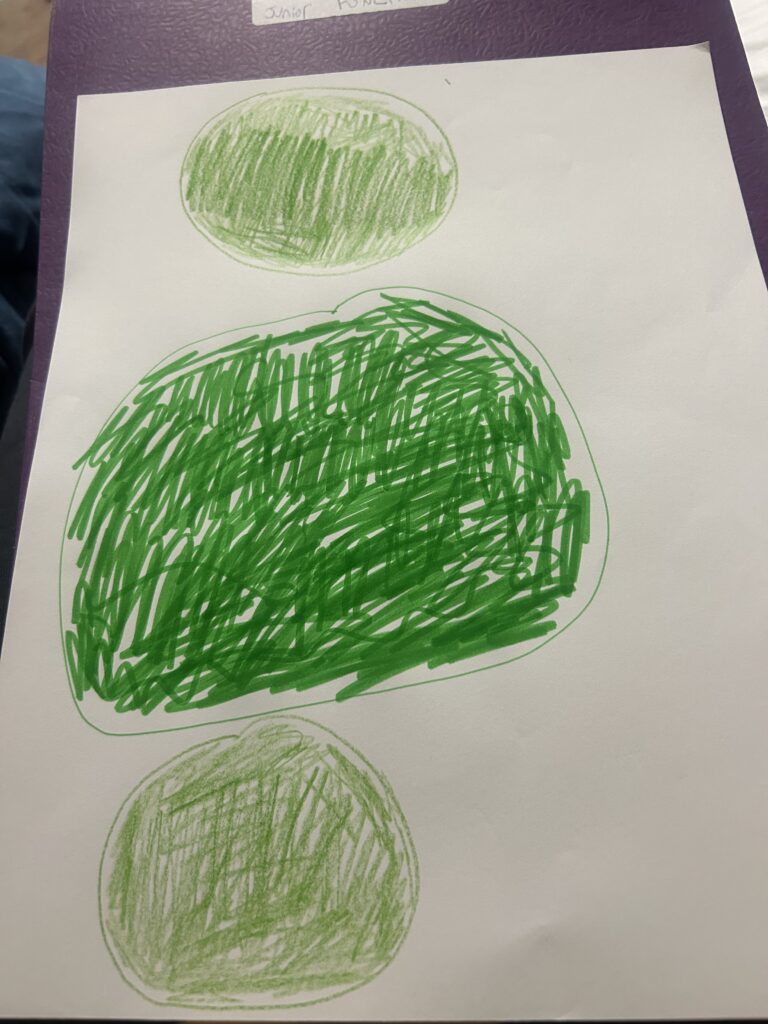
2D Visualization Explanation: My Time Alone
My 2D Visualization was recorded on Friday, February 6th. The 2 Green Circles represent the beginning and end of the day when I was alone. The one large green circle in the marker in the middle represents the big chunk of time from 3:00-11:00 PM when I was either with my mother, my friends, or other people. Why are they green circles? The green circles are there because just like how whether it’s in colored pencil or marker, the color is still green, it didn’t matter when I was alone, or with other people, I still had a good time and felt comfortable regardless of the situation.
-
My Data Project
For my Data Project, the topics that I am tracking are “My Time Alone” and “Balancing My Schedule.” I tracked “My Time Alone” on Friday, February 6th and “Balancing My Schedule” from Tuesday, February 3rd to Sunday, February 9th. I tracked all of my data by jotting down everything that I did each hour on the note’s app on my phone, and then at some point during each day, I would open a new google doc on my laptop and update it by putting the new information on to it. What’s been easy is remembering how I felt while doing everything, because my feelings of what I do consistently typically don’t change. However, what was difficult was remembering to jot down my schedule consistently for an entire week. It definitely took a toll on my brain, and to be honest, there were times that I would forget for almost an entire day. However, because I have a sharp memory of what I did, and because I have a routine of whenever I go to class, work, do schoolwork, or exercise, I was able to retain the previous information easily. As far as the results go, A lot of it wasn’t very surprising, I did pretty much what I thought I was going to do, I felt how I thought I was going to feel, and I spent about as much time alone as I anticipated, so a lot of it wasn’t very surprising. However, what was surprising was how easily I was able to remember everything I did throughout the day for days straight without looking at any notes. Everyone knows that consistency is the key to success, but it’s also the key to sharp memory because of how common pattern recognition is. As far as what my routine is, imagine going to school, doing homework, working part time, socializing, going to the gym consistently, all in the same pattern with a bunch of relaxing breaks in between. That’s what my typical day as a college student looks like.
-
Hello, my name is Jack, and I am a sophomore accounting major at Rowan University. I am a member of the John H. Martinson Honors College, and I also hold a part-time job at the university’s dining hall. I’m considering joining more clubs come junior and senior year to help strengthen my resume. Some clubs that I’m considering are Accounting Society, Debate Club, and Financial Management Association. As far as my field goes, I am honestly interested in any firm that has something to do with accounting, whether that would be in audit, tax, financial advising, financial analysis, business analysis, what have you. Not only that, but I have an organized plan as well. I plan on graduating Rowan with at least a 3.5 GPA with at least one internship completed, securing a job at an accounting firm either during my last semester or shortly after graduation, studying for the CPA exam while working in my field, taking and passing the CPA exam, and then finally securing my CPA license with 120 credits and over two years of experience under my belt. Whether that plan follows through or not, I am optimistic and looking forward to what the future holds.
What I want to get out of my Digital Humanities class is more knowledge about digital humanities as a whole from the past, present, and future. And you might ask, “What about digital humanities do you want to learn about?” To answer your question, I want to learn about the major topics of digital humanities, the gender equality, racial equality, ethnic equality, LGBTQ equality, etc. rights of digital humanities. I want to learn about the progression that was made over the years, what was done right, what was done wrong, and what needs to be done in the future. I especially want to know what’s going on currently in the state of the world that’s effecting the major aspects of digital humanities, good or bad. I want to learn about what basics of digital humanities that the people interested agree on and disagree on. I want to learn about the most interesting aspects of digital humanities, and I am certain that this course will teach me just that.